This handbook is a practical guide to help women and girls with disabilities who defend human rights stay safe and access support. It emphasizes five core principles: do no harm, respect the survivor’s choices, maintain confidentiality while collecting only essential information, ensure accessibility, and promote collective safety rather than working alone.
The handbook explains that disability rights are human rights protected by Ugandan and international law. Women and girls with disabilities often face heightened risks because of the combined effects of gender discrimination, disability-related barriers, and their advocacy work. Safety therefore, includes physical, digital, and emotional well-being.
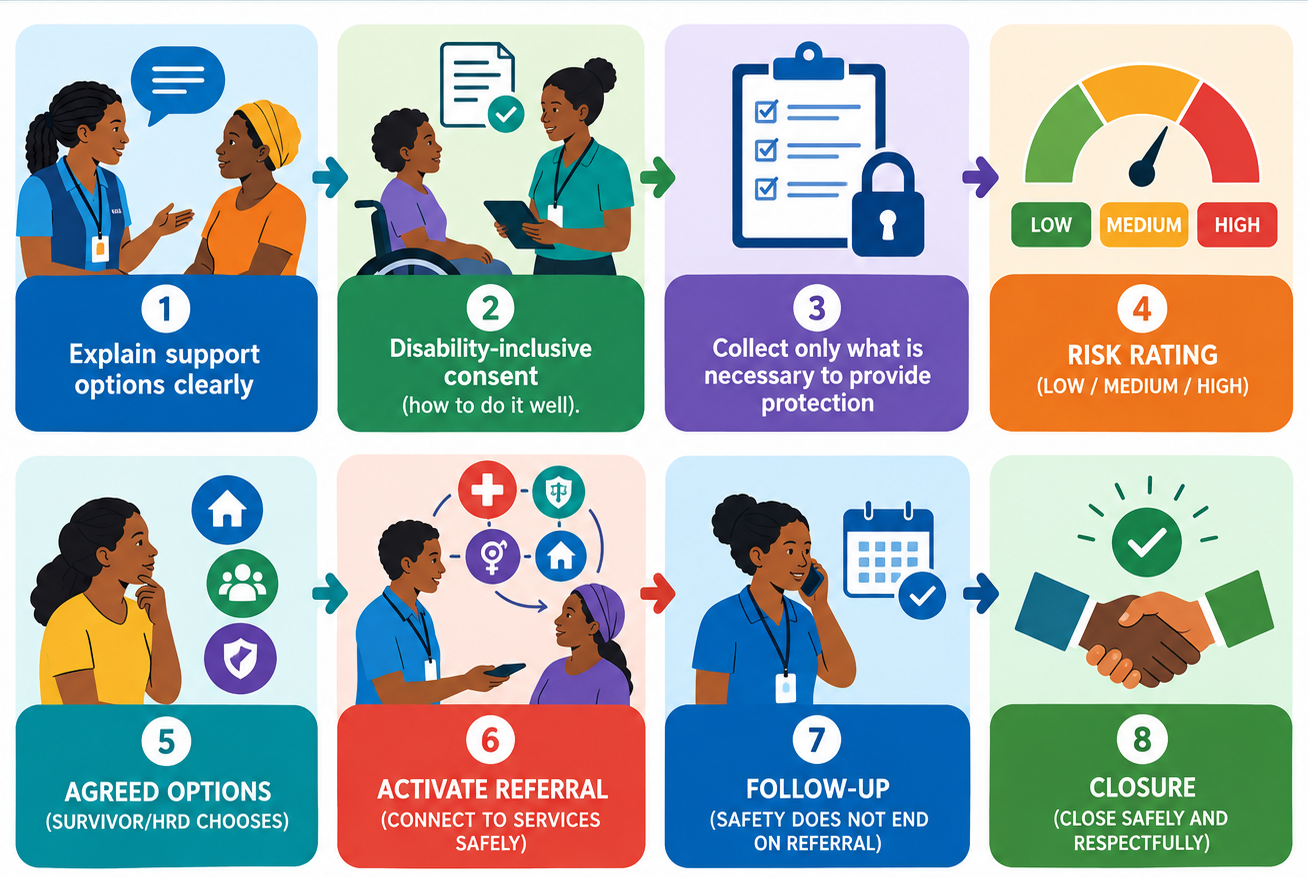
Its central tool is an eight-step protection pathway: ensure immediate safety, obtain informed consent, collect only necessary information, assess risk, discuss support options, make safe referrals, follow up regularly, and close cases only when risk is low and the survivor agrees. Throughout, trauma-informed and collective care are stressed, recognizing that healing and protection are most effective when survivors are treated with dignity, believed, and supported by trusted networks.
Topics
Know Your Rights
Human rights are daily needs
Human rights are not “big English” only for lawyers. Human rights are daily needs:
- Being safe at home and in the community,
- Accessing health services without humiliation,
- Being listened to at LC or police,
- Going to school, working, owning property,
- Participating in meetings and leadership.
- WGDs are rights-holders (they have rights).
- Government bodies and service providers are duty-bearers (they must respect, protect, and fulfil rights).
- Families and communities also have responsibilities to avoid harm and support dignity.
- Right to dignity and equality,
- Freedom from violence and torture,
- Right to health and SRHR information,
- Right to education and economic opportunity,
- Right to participation and leadership,
- Right to access justice and effective remedy,
- Right to privacy and confidentiality.
Uganda Constitution (highest law)
The Constitution of the Republic of Uganda is the “mother law.” All other laws must follow it. It says:
- All people are equal before and under the law.
- No one should be treated in a cruel, inhuman or degrading way.
- Everyone has a right to life, dignity, liberty, privacy and property.
- People have the right to speak, organise and associate peacefully.
Persons with Disabilities Act, 2020
The Persons with Disabilities Act, 2020 is a Ugandan law that talks directly about the rights of persons with disabilities. It aims to remove barriers and promote inclusion.
It says, among other things, that:
- 1 Persons with disabilities have the same rights as other people.
- There must be no discrimination in services such as health, education, work, justice and participation.
- Government and service providers should take steps to make services accessible (for example, ramps, sign language, information in accessible formats).
- Reasonable accommodation should be given when needed.
When we support survivors and HRDs, we often handle sensitive information: names, phone numbers, health details, locations, photos, case stories.
Good practice (and Ugandan data protection law) says:
- Personal information must be kept private, safe and secure.
- We should collect only the minimum data needed to help.
- We should get consent before sharing information with other actors (health workers, police, legal aid, shelters, partners).
Understanding Disability
Disability is not weakness, one has an impairment.
Many people think disability means weakness. This is not true. A person may have an impairment, but disability becomes worse because of barriers
- Physical barriers (stairs, long distances),
- Communication barriers (no sign interpreter),
- Attitude barriers (stigma, abuse),
- Institutional barriers (forms, procedures, discrimination).
“People with disabilities are rights-holders.” (State and society have duties, including reasonable accommodation.)
Reasonable accommodation means practical adjustments so a person can participate equally. Examples:
- Sign language interpretation,
- Extra time to explain or respond
- Large print, audio, easy-read forms
- Wheelchair access or holding the meeting in an accessible venue
- Allowing a trusted support person when needed (without replacing the person’s voice).
WGDs HRDs have the right to receive services without discrimination. This means health facilities, police, and local leaders should provide;
- privacy,
- respectful treatment
- and reasonable accommodation (such as extra time, accessible communication, and safe seating arrangements).
If a service provider refuses support because of disability, gender, or stigma, that is discrimination and should be documented and escalated through IDIWA and appropriate oversight mechanisms.
Human Rights Defender (HRD)
Under this section we look at who an HRD is, the work they do, their values, smart activism and the unacceptable behaviour.
An individual defending rights of others in a peaceful manner.
You may be a defender if you:
- Report cases of violence/discrimination
- Help survivors access services
- Speak in community dialogues, radio, schools, churches,
- Organise other WGDs
- Advocate for disability rights, SRHR, land rights, justice, environment.
- Respect people and dignity.
- “Do no harm.”
- Privacy and confidentiality.
- Consent and choice.
- Work with others (collective safety).
- Courage with caution (smart activism).
- Defending rights in a peaceful manner
Smart activism means defending rights without unnecessary exposure. WGDs HRDs should plan safer ways to act, such as working with a buddy, using safe avenues, avoiding sharing sensitive information publicly, and coordinating with IDIWA before taking high-visibility steps. Smart activism is not fear—it is strategy. It protects lives, protects evidence, and supports long-term advocacy.
- Sharing someone’s story without consent,
- Forcing survivors to report,
- Taking bribes,
- Discrimination or insults,
- Abuse of power by allies or staff,
- Using support to control someone’s choices.
Stay Safe
Be aware of your surroundings, take the necessary security measures and avoid dangerous places.
- Trust your instincts—if something feels unsafe, take it seriously.
- Avoid moving alone in risky places or late at night when possible.
- Use a buddy system for meetings and visits.
- Tell someone where you are going and your expected return time.
- Save emergency numbers and IDIWA focal contacts.
- Keep a small emergency plan: where to run, who to call, what to carry.
Physical safety planning must include mobility realities. Where a WGDs HRD uses a wheelchair, crutches, or has low vision, safety planning should identify accessible routes, safe transport providers, and safe pickup points. Where a WGDs HRD cannot move quickly, the plan should prioritise early exit, public places, and pre-arranged support (buddy or neighbour). In high-risk contexts, avoid unpredictable roadside stops and ensure someone knows the route and expected arrival time.
WGDs may face threats from known people (partners, family, caregivers, neighbours). Safety planning must consider:
- dependence (transport, money, support person),
- privacy challenges,
- stigma and gossip,
- control of movement or phones.
Practical actions:
- identify safe neighbours/relatives,
- agree a distress signal,
- keep essential items in one place (ID, meds),
- avoid confronting violent persons alone,
- inform IDIWA early.
Psycho-security protects emotions, thoughts, and wellbeing. WGDs HRDs may face stress, fear, panic, shame, depression, or numbness after threats or violence.
Simple mind safety steps:
- pause and breathe (slow breathing),
- grounding (5-4-3-2-1),
- talk to a trusted person,
- avoid reading abusive messages repeatedly,
- rest and reduce workload temporarily,
- seek counselling or peer support.
- No recordings without consent.
- Use respectful language.
- Keep names private when discussing cases.
- Agree a safe venue and exit route.
- Provide accessibility support (interpretation, seating, easy language).
- Have a focal person for distress/safeguarding.
This is a simple planning method:
Before: prevent and prepare (reduce exposure, plan exits, set check-ins).
During: manage safely in the moment (de-escalate, leave early, stay in public spaces).
After: recover and learn (debrief, update plan, referrals, emotional support).
Spot a Threat
Threats can be physical, sexual, emotional, economic, digital, or institutional.
A threat is anything that can harm you or scare you.
Common threats to WGDs HRDs
- Stigma and rumours: “She is useless,” “She is lying,” “She wants attention.”
- Domestic and family violence: control, confinement, denial of support.
- Harassment by leaders or institutions: public humiliation, denial of services.
- Sexual exploitation: targeting because of vulnerability or stigma.
- Physical attacks: assault, being followed, intimidation.
- Police threats: arrest, intimidation, “you are disturbing peace.”
- Digital threats: blackmail, leaked photos, hacking, cyber bullying, impersonation, hate campaigns.
- Economic threats: withholding money, stealing assistive devices, blocking work.
WGDs HRDs may face threats linked to dependency, stigma and gender norms. These include withholding assistive devices, controlling phones, locking someone indoors, threatening abandonment, sexual exploitation by people who “offer help,” and mocking credibility (“she is disabled, she is lying”). These threats can be high risk because the threat actor may be close and have daily access.
- Repeated insults,
- Hostile messages
- Strangers near home,
- People asking about your movements,
- “Planning meetings against you,”
- Sudden change in behaviour of a known violent person.
Treat the case as urgent if threats mention death, disappearance, weapons, rape, or if the abuser lives in the same home. Urgent action may include immediate safety relocation, medical care, legal referral, and protection committee activation. The goal is rapid harm reduction, not a slow process.
Check the Risk
Risk = how likely harm is + how serious it could be.
- Low: isolated incident, low power threat source, safe support available.
- Medium: repeated threats, increasing hostility, some vulnerability.
- High: threat source has power/violence history, danger is active now, life/safety at immediate risk.
Vulnerabilities are the gaps that make harm easier, such as isolation, controlled phone access, dependence on unsafe caregivers, or lack of transport.
Protection capacities are the strengths that reduce danger, such as trusted allies, buddy systems, safe transport, accessible services, legal support, safe housing, and IDIWA follow-up.
- What is happening?
- Who is doing it?
- Where and when is it happening?
- What could happen next if nothing is done?
- Who can help safely?
Follow the Protection Pathway
- Move away from danger (public place, trusted neighbour, health facility, safe contact).
- Call or alert a trusted person (buddy/IDIWA focal/safeguarding focal person).
- Do not confront the threat actor alone.
- Seek medical help if injured or after sexual violence (time matters).
- Preserve evidence safely (notes/screenshots) without posting online.
- Start a simple safety plan (safe place, safe contacts, check-in time).
- Use simple words, one question at a time.
- Confirm understanding: “Can you tell me what you understood?”
- For Deaf WGDs HRDs: use trusted interpretation or written communication.
- For persons with intellectual disabilities: use easy-read explanations and allow time.
- Speak directly to the WGDs HRD, not only to caregivers.
- Ensure privacy (caregivers or partners should not force answers).
Collect only what is necessary to provide protection:
- What happened (short description)
- When and where (general)
- Who is involved (if safe to record)
- Immediate safety concerns
- Urgent needs and preferred support option
- Risk indicators (e.g., threats, violence history, abuser proximity)
- Preferred communication method.
Risk rating helps IDIWA decide what action is required and how fast. It also prevents under-reacting (which can endanger the person) and over-reacting (which can expose them or remove their control).
- Low risk: isolated incident, low power threat source, person feels safe now, supports available.
- Medium risk: repeated threats, growing hostility, person is worried, some vulnerability.
- High risk: threat actor has power or violence history, abuser nearby, threats of serious harm, person unsafe now.
Depending on the case, options may include:
- Medical care (injury, sexual violence response, documentation)
- Psychosocial support (counselling, peer support)
- Legal support (advice, protection orders, court processes)
- Police reporting (only if the person chooses)
- Safe shelter or temporary relocation
- Mediation only where safe and chosen (never forced in violence cases)
- Digital safety support (blackmail, harassment, account security)
- Community protection measures (trusted leaders, safe neighbours).
What referral means
Referral means connecting the WGDs HRD/survivor to another service provider that can help (health, legal, psychosocial, shelter, digital protection).
Referral rules
- Get consent before contacting any provider.
- Share only necessary information.
- Use safe communication channels.
- Where possible, accompany the person or arrange safe accompaniment.
- Document referral action and follow-up date.
Why follow-up is protection
Follow-up reduces risk by identifying escalation early and ensuring the person actually received support.
Follow-up timelines
- Standard cases: Day 7 and Day 14 follow-up.
- High risk cases: same-day and frequent follow-ups (daily or as needed).
- Digital blackmail cases: follow-up within 72 hours (because escalation is common).
What to check during follow-up
- Is the person safe today?
- Has the threat reduced or increased?
- Any new threats, stalking, retaliation, online harassment?
- Did they access the referral service?
- What was the outcome?
- What additional support is needed?
- Psycho-security check: sleep, fear, panic, distress, isolation.
A case can be closed when:
- risk is low and stable,
- referrals have been completed (or survivor chooses to stop),
- the WGDs HRD/survivor agrees to closure,
- the safety plan is in place and understood.
Get Help and Referrals
Stakeholders and what each should do.
Health workers:
- urgent treatment,
- privacy,
- respectful care,
- reasonable accommodation,
- documentation/referrals.
Legal aid providers:
- legal advice,
- protection orders,
- representation,
- case follow-up.
- counselling,
- peer support
Police/GBV desk:
- respectful reception,
- statement recording,
- safety support,
- no discrimination.
Community Development Officers and social workers:
- support services linkage,
- community protection follow-up.
Community protection support
- support referral and safety;
- avoid forced reconciliation in violence cases.
- coordinates protection pathway,
- maintains confidentiality,
- follows up and monitors safety.
Protect Your Phone
Phones and computers should have passwords,
Use a strong password not obvious patterns.
Secure accounts with two-step verification
Reduce exposure (limit location sharing)
- Do not post evidence on social media.
- Store evidence securely (password-protected device).
- save evidence (screenshots, URLs, usernames, dates),
- secure accounts (password change, two-step verification),
- reduce exposure (privacy settings, limit location sharing),
- assess physical risk (leaks can lead to physical attacks),
- refer to digital security support partners where available.
- Share evidence only with authorised persons and only with consent.
- Use codes instead of names where possible.
Trauma and Collective Care
Trauma is what happens inside a person after serious harm or fear.
Trauma is the deep stress response that can happen after a person experiences or witnesses harm, fear, or serious threat. Trauma is not “weakness.” It is the body and mind reacting to danger. Trauma can come from one major incident (e.g., assault) or from repeated smaller harms over time (e.g., stigma, harassment, threats, discrimination).
Trauma can show differently for different people. Common signs include:
- Sleeping poorly, nightmares, fear of being alone
- Panic, fast heartbeat, shaking, sweating
- Feeling numb, “blank,” or disconnected
- Anger, irritability, crying easily
- Poor concentration, forgetting things
- Avoiding places/people linked to the incident
- Headaches, stomach pain, body aches
- Shame, self-blame, hopelessness
- Increased substance use (for some people)
What is trauma-informed care?
Trauma-informed care means providing support in a way that recognises trauma and does not cause more harm. It avoids blaming, forcing disclosure, humiliating, or rushing a survivor. It helps the person feel safe, respected, and in control of decisions.
Why trauma-informed care matters for WGDs HRDs
Trauma-informed care is critical because WGDs HRDs and survivors are often:
- Not believed due to stigma or disability stereotypes
- Exposed to unsafe environments while seeking help
- Dependent on others for transport or communication
- At risk of retaliation if information is leaked trauma-informed care protects dignity and increases safety, reporting, and recovery.
The “5 Principles” of Trauma-Informed Care
- Safety – physical and emotional safety comes first.
- Trust – be honest, consistent, and keep promises.
- Choice – provide options; the person decides.
- Collaboration – work with the person, not on them.
- Empowerment – build confidence, control, and agency.
Psychological First Aid is immediate, humane support after distress. It is not counselling, and you don’t need to be a therapist. It focuses on helping the person feel safe and connected, and linking them to support.
Look
- Check safety (is there danger now?)
- Check urgent needs (injury, medical care, safe shelter)
- Observe distress signs (panic, confusion, shutdown)
Listen
- Listen calmly, without pressure
- Use simple questions: “Are you safe now?” “What do you need most?”
- Do not force details
- Validate feelings: “That sounds frightening.”
Link
- Connect to support: medical, psychosocial, legal, shelter, trusted person
- Help with practical next steps
- Plan follow-up
“Buddy check” tool
- “Are you safe now?”
- “Where are you (general)?”
- “Do you need transport/help?”
- “When should I check again?”
What is collective care?
Collective care means safety and wellbeing are supported as a group, not left to individuals.
Why collective care matters for WGDs HRDs
WGDs HRDs are often isolated by stigma, dependence, or fear. Collective care reduces isolation and creates safety networks. It also strengthens courage, consistency, and sustainability in activism.
Examples of collective care
- Buddy system during travel and visits
- Safe check-in routines during high-risk work
- Peer support circles (short monthly or after incidents)
- Group transport support for risky appointments
- Sharing safety information privately (not in open groups)
- Joint planning before public advocacy actions
- Rotating tasks so one person does not carry all the risk
- Emergency response contact tree (who calls who)
Collective care rules (to prevent harm)
Collective care must be safe. Agree on:
- No gossip about cases or survivors
- No sharing names/photos without consent
- Minimum data in WhatsApp groups
- Respect and accessibility in meetings
- Non-retaliation: nobody should be punished for reporting abuse
- Confidentiality: only authorised persons handle cases
Roles and Service Standards
Protection works best when everyone knows who does what, how decisions are made, and how confidentiality and safeguarding are enforced.
The WGDs HRD/survivor is the main decision-maker in their own case and protection plan. They have the right to safety, dignity, privacy, and choice.
Responsibilities:
- Report the incident or ask a trusted person to report.
- Choose the support options they prefer (medical, legal, psychosocial, etc.).
- Give or refuse consent for information sharing and referrals.
- Participate in safety planning where possible (safe place, buddy, check-ins).
- Communicate changes in risk (new threats, stalking, retaliation) as soon as possible.
Male allies support WGDs HRDs without dominating or controlling decisions.
What good allyship looks like:
- Supports safe transport and buddy accompaniment.
- Protects confidentiality (no sharing names/photos/stories).
- Challenges stigma and harmful norms among men and leaders.
- Follows the WGDs HRD’s choices and pacing.
- Escalates emergencies safely to IDIWA when requested.
What must never happen:
- Pressuring the survivor to report.
- Demanding details or “proof.”
- Using support to control, exploit, or harass.
- Sharing stories without consent.
A focal person is a trusted community contact who helps with first response, safety planning, and referrals, especially when IDIWA staff are not nearby.
Responsibilities:
- Receive reports safely and confidentially.
- Use the Step 1–3 pathway: listen, make safe, consent + minimum data.
- Contact IDIWA case officer/safeguarding focal person quickly for guidance.
- Support safe transport and accompaniment where possible.
- Follow-up with check-ins (especially for high risk).
- Keep minimal notes securely and hand them to IDIWA (do not store on shared phones).
The case officer leads case management and coordinates protection actions.
Responsibilities:
- Receive and document reports using minimum data tools (Annex forms).
- Conduct risk rating and update it over time.
- Coordinate referrals (health, legal, psychosocial, shelter, digital support).
- Ensure accessibility and disability-inclusive communication in every step.
- Keep secure records and update the case log.
- Schedule follow-ups (D7/D14 or more frequent for high risk).
- Close cases safely and respectfully with survivor agreement.
A Protection Committee is a small trusted team within IDIWA that helps make decisions for high-risk cases (e.g., urgent relocation, emergency funds, serious legal escalation).
Core responsibilities:
- Review high-risk cases and recommend protective actions.
- Approve urgent protection measures and resource use (as per IDIWA policy).
- Ensure conflict of interest is declared and managed.
- Ensure documentation and confidentiality of decisions.
- Review trends and strengthen referral networks and SOPs.
Standard Operating Procedures (SOPs) are simple step-by-step guides that help IDIWA and allies respond consistently and safely, especially under pressure.
SOP 1: Incident handling (core pathway SOP)
- Receive report (first contact).
- Make safe (immediate safety + medical priority).
- Obtain consent + collect minimum data.
- Risk rate (Low/Medium/High).
- Agree options (survivor chooses).
- Refer (minimum info, safe channels).
- Follow up (D7/D14 or more frequent).
- Close safely (survivor agrees).
SOP 2: Travel and check-in (buddy safety)
- Inform focal person/buddy before travel.
- Share route and expected arrival time.
- Check-in on arrival.
- Check-in during return.
- If no check-in: buddy/focal follows up immediately.
- If still no response: escalate safely to IDIWA and trusted contacts (avoid public posting).
SOP 3: Evidence and privacy (minimum data + safe storage)
- Ask consent before collecting evidence.
- Collect only necessary evidence (screenshots, short notes).
- Do not post evidence on social media.
- Store evidence securely (locked cabinet / password-protected device).
- Share evidence only with authorised persons and only with consent.
- Use codes instead of names where possible.
SOP 4: Referral activation (safe linkage)
- Confirm survivor’s preferred option and consent.
- Identify suitable service provider (accessible + trusted).
- Contact provider using safe method and minimum data.
- Arrange accompaniment if needed (especially for WGDs).
- Record referral and follow-up date.
- Follow up within 72 hours (or sooner for urgent cases).
SOP 5: Digital threat response (blackmail/harassment/leaks)
- Save evidence (screenshots, dates, usernames, links).
- Secure accounts (change passwords, 2-step verification).
- Reduce exposure (privacy settings; remove location; limit visibility).
- Do not pay blackmail or send more content.
- Assess physical risk (does the person need relocation/safety plan?).
- Report harmful accounts where possible.
- Activate digital support referral if available.
- Follow up within 72 hours.
SOP 6: Working with authorities safely (LC/police/health)
- Go with a trusted person where possible.
- Request privacy and reasonable accommodation (interpretation, extra time).
- Share minimum information.
- Record names, dates, and actions taken (if safe).
- If discrimination occurs, document and escalate through IDIWA.
SOP 7: Safeguarding complaint handling (SEAH/abuse by staff/allies/providers)
- Receive complaint confidentially and respectfully.
- Ensure immediate safety of complainant.
- Do not pressure for details; collect minimum info.
- Escalate to safeguarding focal and leadership as per policy.
- Protect from retaliation; plan follow-up.
- Document action and outcome safely.
SOP 8: Debrief and staff wellbeing after high-stress cases
- Short debrief within 24–72 hours of heavy case.
- Identify risks to staff and focal persons (burnout, threats).
- Agree workload adjustments and support needed.
- Refer staff for psychosocial support where needed.
- Document learning (anonymised).
PROTECTION PATHWAY
Contacts
Telephone numbers